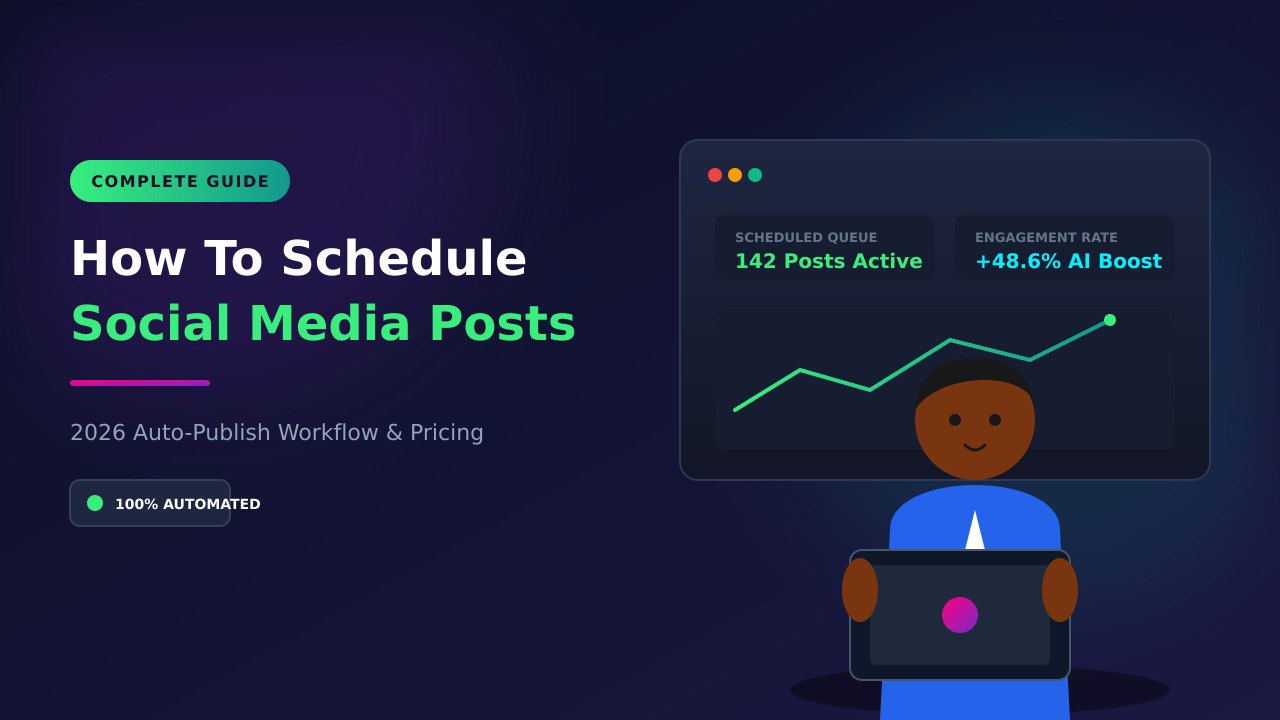
Nigerian businesses no longer compete on hustle alone — they compete on consistency. The brand that shows up on WhatsApp, Instagram, TikTok, and X every single day without fail is the brand that stays top of mind when a customer finally decides to buy. But posting manually across five platforms while also managing orders, deliveries, and customer DMs is a recipe for burnout. That is exactly why learning how to schedule social media posts automatically has become one of the highest-leverage skills for Nigerian founders, social media managers, and agency teams in 2026.
This guide breaks down the tools, the real Naira pricing, the payment workarounds for Nigerian debit cards, and a practical 10-minute workflow that lets you batch and schedule 30 days of content in a single sitting. If you want the short version: the Social AI Platform is built specifically for this market, and you can Start Free Trial before committing a single Naira.
Executive Overview: Mastering How To Schedule Social Media Posts Automatically in Nigeria (2026)
The Evolution of Social Publishing in Nigeria
Five years ago, "social media management" in Nigeria meant logging into Facebook on a laptop, posting a flyer, and hoping for engagement. WhatsApp was treated as a personal messaging app, not a business channel. Instagram was a photo album. TikTok barely registered with mainstream SMEs.
By 2026, the picture has completely inverted. WhatsApp Business has become the de facto storefront for everything from Lagos fashion houses to Abuja real estate firms. Instagram DMs close sales. TikTok drives discovery for products that would never have found an audience through traditional advertising. X (Twitter) remains the fastest channel for brand reputation and real-time customer service in Nigeria's tech and media circles.
That shift created a new operational problem: the average Nigerian SME now manages five distinct inboxes and five distinct publishing calendars. Manual posting does not scale. Scheduling tools moved from "nice to have" to essential infrastructure — and the market responded with platforms that finally accept Naira, Verve cards, and bank transfers.
Key Market Trends
- WhatsApp-first publishing. Broadcast lists, status updates, and catalogue-driven messaging are now core marketing surfaces, not afterthoughts. Schedulers that ignore WhatsApp are only solving half the problem.
- AI-assisted content creation. Nigerian teams are using AI to generate captions, hashtags, and Pidgin-English variants at speed, cutting content production time by 60–70%.
- Data cost consciousness. With mobile data still a meaningful line item for many SMEs, scheduling image-light, high-frequency posts beats dumping heavy video files at peak hours.
- Local payment sovereignty. The era of begging a cousin abroad for a dollar card is ending. Paystack, Flutterwave, and direct bank transfers now power most software subscriptions for Nigerian businesses.
- Consolidation of tools. Teams are abandoning the "one tool per platform" approach in favour of all-in-one schedulers that handle publishing, DM automation, and analytics in one dashboard.
Market Analysis: Top Social Media Management Tools Evaluated
All-in-One Multi-Network Schedulers
The global market is dominated by a handful of names — Buffer, Hootsuite, Later, and Meta's own free Business Suite. Each has genuine strengths, and each has a specific weakness when applied to the Nigerian context.
Buffer is the simplest entry point. Its queue-based scheduling is elegant, and it supports Instagram, Facebook, X, LinkedIn, TikTok, and Pinterest. The friction for Nigerian users is billing: Buffer prices in US dollars and requires an international card, which excludes most Verve cardholders and anyone with a naira-only account.
Hootsuite is the enterprise option. Approval workflows, social listening, and deep analytics make it powerful for banks, telcos, and large agencies. It is also the most expensive tool on this list, and its dollar-denominated billing puts it out of reach for most small Nigerian teams.
Later excels at visual planning. Its drag-and-drop media library and Instagram-first calendar are genuinely pleasant to use. But it is Instagram-centric by design, and WhatsApp Business — arguably Nigeria's most important channel — is not a first-class citizen.
Meta Business Suite is free and native, which makes it attractive. It schedules Facebook and Instagram content reliably and offers basic inbox management. Its limitation is obvious: it only covers Meta properties. TikTok, X, and WhatsApp broadcast workflows sit outside its scope.
That leaves a gap in the market: a tool that covers all five dominant Nigerian channels, bills in Naira, and includes AI content generation. That is precisely the gap the Social AI Platform was built to fill.
Why Leading Teams Choose Social AI
Social AI is an all-in-one social automation and AI platform tailored for Nigerian businesses. Instead of stitching together three subscriptions and two workarounds, teams get one dashboard that publishes to WhatsApp Business, Instagram, Facebook, TikTok, and X — plus AI tools that generate captions and hashtags tuned to local audience behaviour.
The practical advantages Nigerian teams cite most often:
- Naira-native billing. Subscription pricing is quoted in Naira, with no hidden FX markup on renewal.
- Local payment rails. Mastercard, Visa, Verve, Paystack, Flutterwave, and direct bank transfer are all supported.
- WhatsApp Business as a first-class channel. Schedule broadcasts and status content alongside your Instagram and TikTok calendar.
- AI that understands the market. Caption generation that can shift between formal corporate English and relaxed Pidgin depending on the brand voice.
- Support in your timezone. Real humans, reachable through Customer Support & Inquiries, not a ticket queue that responds at 3 a.m. West Africa Time.
| ₦7,500 – ₦12,000 / month |
| ₦35,000 – ₦55,000 / month |
| ≈ ₦9,000 – ₦95,000 / month (USD-billed) |
| ≈ ₦38,000 – ₦190,000 / month (USD-billed) |
| ≈ ₦22,000 – ₦78,000 / month (USD-billed) |
Pricing shown is indicative for 2026 planning purposes. Always confirm current rates on the Pricing & Subscription Plans page before budgeting.
Essential Features: Auto-Scheduling, Cross-Posting & Smart Timing
Publishing Across 5+ Networks
The core promise of any scheduler is simple: write once, publish everywhere. In practice, quality varies enormously. A good cross-posting engine does not just blast identical text to every platform — it adapts.
Instagram rewards visual-first captions with a strong hook in the first line. X demands brevity and often benefits from thread structure. TikTok captions work best when short and search-optimised. WhatsApp broadcasts need a conversational, almost personal tone. Facebook tolerates longer storytelling.
Social AI handles this by letting you draft a master post and then adjust per-channel variants within the same composer. You can schedule a product launch to Instagram at 7 p.m., a shorter teaser to X at noon, a TikTok clip at 8 p.m., and a WhatsApp broadcast to your customer list at 10 a.m. the next morning — all from one screen, all queued in advance.
Smart timing adds a second layer. Rather than guessing when your Lagos audience is scrolling, the platform analyses historical engagement and recommends posting windows. For most Nigerian B2C brands, that means early morning (6–8 a.m. commute), lunch (12–2 p.m.), and evening (7–10 p.m.). B2B audiences skew toward weekday mornings.
AI Caption & Hashtag Generation
Writer's block is the silent killer of content calendars. AI caption generation solves it by turning a one-line brief into three ready-to-publish variants in seconds.
In the Nigerian context, the quality of that AI matters. Generic models produce captions that sound like they were written for a California startup. A well-tuned system understands local idioms, can toggle between polished corporate English and relaxed Pidgin, and knows that hashtags like #LagosBusiness, #NaijaBrand, and #ShopSmallNigeria carry real discovery weight.
Hashtag generation should also be tiered: a mix of high-volume tags for reach, mid-tier tags for competition, and niche tags for conversion. Scheduling tools that generate 30 identical hashtags on every post actively hurt reach on Instagram. The better approach is a rotating set of 8–12 relevant tags per post.
For teams that want to go deeper on AI-assisted content, the Best Social Ai App in Nigeria: Complete 2026 Guide, Pricing & Platform Comparison covers the wider tooling landscape, while the Best Social Ai Chatbot in Nigeria: Complete 2026 Guide, Pricing & Platform Comparison explores automated DM and customer-service flows.
Pricing Breakdown & Total Cost of Ownership in Nigeria
Starter vs Agency Tiers in ₦
Budgeting for social automation in Nigeria requires looking beyond the sticker price. The real total cost of ownership includes the subscription, the FX spread on dollar-billed tools, the cost of a failed payment and the resulting downtime, and the labour hours saved.
Starter tier (₦7,500 – ₦12,000/month). Designed for solo founders, small retailers, and single-brand managers. Typically covers one workspace, five connected channels, scheduled posting, AI caption generation, and basic analytics. At ₦10,000 a month, that is roughly ₦333 per day — less than a plate of lunch in most Nigerian cities, for a system that replaces two to three hours of manual posting weekly.
Agency tier (₦35,000 – ₦55,000/month). Built for agencies and in-house teams managing multiple brands. Includes multi-client workspaces, team member roles, approval workflows, advanced reporting, and chatbot automation. An agency charging ₦150,000–₦400,000 per client per month can service five to ten